
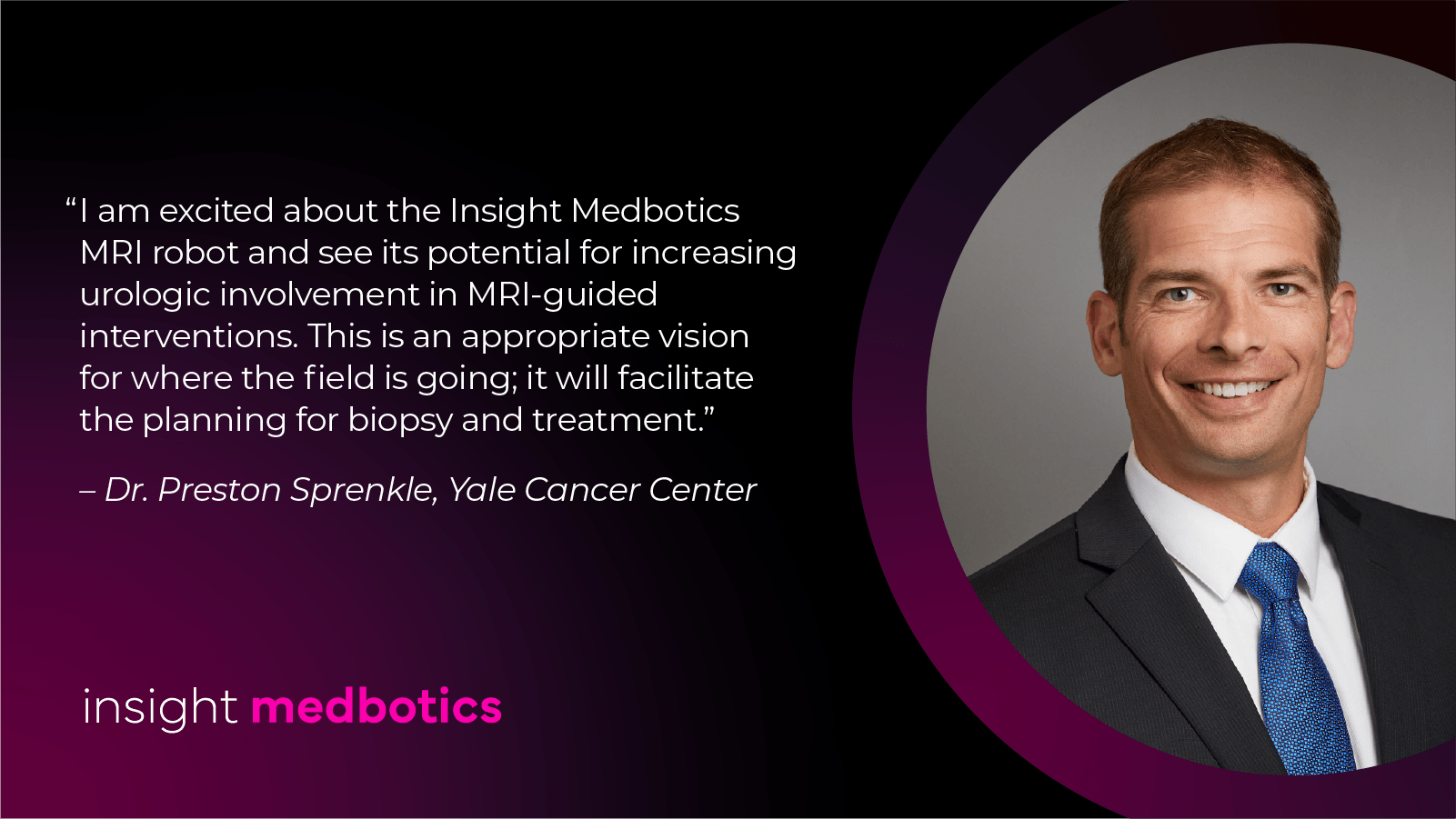
MRI has become a cornerstone of the urologic diagnostic toolkit. But for urologists like Dr. Preston Sprenkle, the vision for MRI goes beyond imaging. Where the MRI is foundational for a fully integrated continuum of urologic care from biopsy to treatment, powered by the unmatched visualization.
Across our conversations with more than 50 urologists, we’ve heard a consistent challenge: while institutions may have available MRI scanner capacity, urologists have lacked the specialized, precision tools required to efficiently unlock the full potential of that environment for interventions.
Dr. Sprenkle is pushing the field of prostate cancer care towards true precision by building a strong clinical and economic case for urologic ownership of MRI-guided procedures and accelerating the shift toward precision-based, MRI-native intervention. His perspective is featured in Urology Times’ article “Unmet Needs and Emerging Solutions in MRI-Guided Prostate Cancer Care,” which outlines the growing role of MRI-guided technologies and the opportunity to transform MRI from a diagnostic endpoint into an interventional and therapeutic platform.
The Institutional Gap: Why MRI Capacity Goes Unused in Urology
A common paradox in many hospitals is that while MRI capacity may be available, urologists cannot effectively utilize it. The barrier is not a lack of scanner time, but rather a lack of interventional tools designed for the urologist's workflow. Because existing in-bore MRI procedures are often too cumbersome or time-consuming to be financially or operationally viable, urologists are forced to remain guests in the MRI suite, rather than procedural owners.
The Problem with Approximation: Why MRI-Ultrasound Fusion Isn’t Enough
To bypass the lack of interventional MRI tools, urologists moved toward MRI-ultrasound fusion, as a compromise. Fusion relies on an approximation of a previously taken static MRI image overlaid onto a real-time ultrasound image.
This creates the precision gap. Physicians are essentially guessing the location of a lesion based on a prior scan, which can lead to targeting errors during biopsy and incomplete margins during focal therapy. For an institution, this means higher rates of re-biopsy or poor treatment outcomes.
Glenn™: Enabling MRI-Guided Urologic Intervention with Robotic Precision
Insight Medbotics is developing Glenn™ to solve this specific institutional friction. By bringing robotic precision directly into the MRI suite, Glenn allows urologists to leverage existing MRI capacity to access high-value procedures that can be performed efficiently.
The business case for Glenn is built on three pillars:
- Procedural Efficiency and Reimbursement: Glenn is designed to facilitate MRI-native interventions with a room booking time comparable to traditional in-office procedures, allowing for higher reimbursement rates without sacrificing throughput.
- Operational Asset Utilization: By enabling urologists to perform biopsies and treatments in the MRI, institutions can maximize the ROI on their existing magnets during available scanner slots or extend use of sunset scanners.
- A Continuum of Care: Standardizing spatial and clinical data on an MRI platform to digitally track the same lesion from diagnosis to treatment.
Unlock a new model for MRI-Native Interventions
Urologists are no strangers to integrating advanced imaging into their clinical and business workflows. The widespread adoption of PET/CT systems for prostate cancer diagnosis—largely driven by the powerful combination of clinical utility and the financial incentives surrounding PSMA tracers—proved that urologists can pivot rapidly when a technology aligns with both patient care and practice economics.
Glenn™ unlocks a similar opportunity for MRI, by removing traditional workflow barriers, urologists can develop a strong, independent practice centered on MRI-native procedures. This opportunity becomes even more compelling through the use of mobile imaging service providers.
The mobile MRI service provider market, often referred to as "MRI on a truck," represents a $4 billion U.S. annual market. These mobile units provide a flexible solution to access 1.5T scanners that can be deployed directly to the urologist's premise, whether that is their preferred ambulatory surgical center (ASC) or a community hospital’s OR. This enables urology practices to operate independently of a hospital radiology department’s schedule.
Closing the Precision Care Loop
By integrating Glenn™ into their practice, urologists are not just adding a robot; they are establishing a new standard of care that turns a fragmented journey into an integrated, MRI-native pathway. For institutions, it means maximizing the utility of their MRI assets. For urologists, it means finally having the tools to match their vision of precision prostate cancer care. And for patients, it means a more precise, personalized path to treatment.